
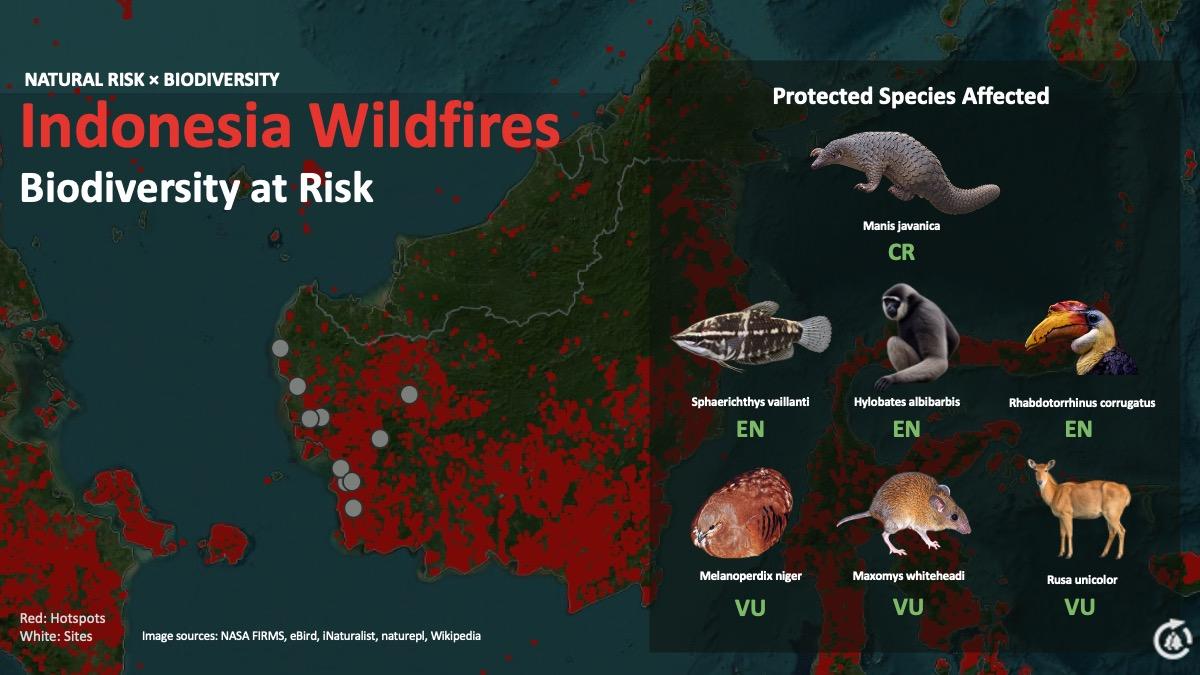
Indonesia’s forest and land fires have once again drawn attention. According to official data, the area affected by forest and land fires exceeded 285,000 hectares by the end of July 2026.
But the relationship between forest fires and biodiversity is not only about how many hectares have burned. It is also about how habitats, hydrology, corporate concession areas, and supply chains are exposed to nature-related risks together.
CoCoTree brings fire hotspots, company locations and species data onto a single map. Through our natural risk analysis platform, we can quickly identify conservation-priority species that may face significant impacts from fire risk.
When fires overlap with peatlands, forests, freshwater habitats or corporate concession areas, biodiversity risks may cascade into water resources, land productivity, supply chains, regulatory compliance, finance and corporate sustainability management.
For companies, this is an important starting point for understanding natural resource dependencies. Hydrological regulation, soil carbon, forest ecosystems and biodiversity are forms of natural capital that many industries rely on to maintain operations and supply-chain stability.
The first step in nature-related risk management is to put fragmented data back on the map. The next is to combine time-series data, land boundaries, and field surveys to turn potential exposure into verifiable and trackable action.
Start with a map. Understand how Indonesia’s forest fires connect biodiversity, corporate nature-related risk, and sustainability. And consider whether Taiwan, as part of global value chains, may face related issues as well.
Sources:
Trade Development Agency: https://lnkd.in/eBziz3CJ
NASA: https://lnkd.in/e3FFPnK7